
The Cold War’s Silent Sentinel: How JUMPSEAT Redefined Space Intelligence
A recent limited declassification by the National Reconnaissance Office (NRO) has officially acknowledged JUMPSEAT a pioneering U.S. satellite program that for decades served as an “ear in the sky,” collecting signals intelligence from a vantage point far from the conventional Low Earth Orbit (LEO).

JUMPSEAT: The Secret Cold War Signals Intelligence Satellites
The history of space reconnaissance is often associated with high-resolution imagery and optical photography. Yet some of the most consequential missions were designed not to see, but to listen. Between 1971 and 1987, the United States launched a highly secretive series of missions known as JUMPSEAT. The program marked an important step in how space systems could support national security during a period of intense geopolitical tension.
NRO Declassifies JUMPSEAT Program Details
According to the NRO, JUMPSEAT comprised eight missions designated under numbers 7701 to 7708. The satellites were launched from Vandenberg Air Force Base in California (now Vandenberg Space Force Base). Developed within the NRO’s Air Force component (commonly referred to as “Program A”) under a compartment known as “Project EARPOP” JUMPSEAT became the United States’ first-generation signals-collection satellite system designed to operate from a highly elliptical orbit (HEO). Some subsequent reporting suggests that not every launch may have reached its intended orbit, but the NRO’s announcement emphasizes the program’s operational impact and longevity.
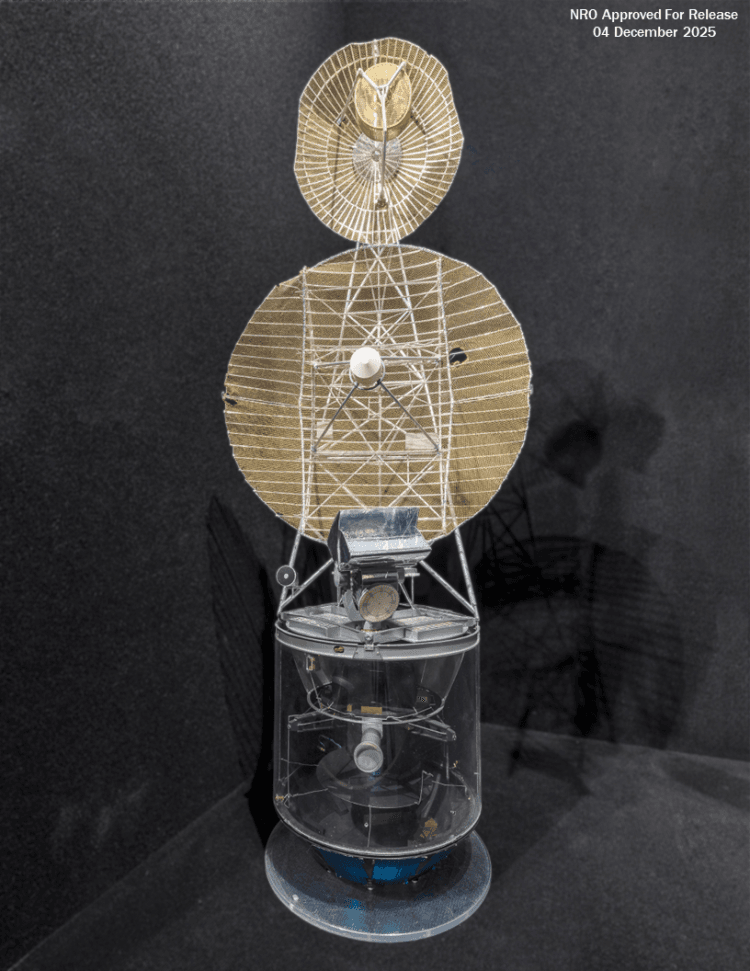
JUMPSEAT Mission: Collecting Electronic Emissions and Signals Intelligence
JUMPSEAT’s core mission, as described by the NRO, was to monitor adversarial offensive and defensive weapon-system development by collecting “electronic emissions and signals”, as well as communications intelligence (COMINT) and foreign instrumentation intelligence (FISINT). In practical terms, this kind of collection can include intercepting and analyzing electromagnetic emissions associated with communications, radars and instrumentation signals tied to weapons development and testing. The NRO notes that the resulting data was downlinked to U.S. ground processing facilities and then provided to organizations including the Department of Defense, the National Security Agency (NSA) and other national security elements.
Why JUMPSEAT Used Highly Elliptical Orbit Instead of LEO
What set JUMPSEAT apart from earlier U.S. electronic surveillance satellites such as those operating from Low Earth Orbit - was its orbit. LEO systems can have limited collection windows over a given region on each pass. The NRO and its mission partners pursued a different vantage point: a Molniya-type highly elliptical orbit, chosen specifically for the extended time it allows a satellite to dwell over high-latitude regions of the Northern Hemisphere.
Molniya Orbit Advantage: Kepler’s Second Law in SIGINT Operations
The orbital advantage can be understood through Kepler’s second law: an orbiting body moves fastest near perigee (closest approach) and slowest near apogee (furthest distance). With an orbit designed so that apogee occurred over the far Northern Hemisphere at roughly 39,000 to 40,000 kilometers in widely cited descriptions JUMPSEAT could spend prolonged periods “loitering” high over northern latitudes. This geometry translated into significantly longer collection windows over strategically important regions than would be possible from LEO alone.
JUMPSEAT Legacy: Precursor to Modern HEO SIGINT Satellites
Over decades of service, JUMPSEAT demonstrated the value of highly elliptical orbits for signals collection. The NRO states that the satellites ultimately operated in transponder mode before they were removed from service, with the program concluding in 2006. The declassification also highlights JUMPSEAT’s role as a foundational predecessor to later highly elliptical orbit satellite programs. While the details of successor systems remain largely classified, multiple open-source accounts have long assessed that later U.S. SIGINT satellites continued to exploit similar orbital regimes.
Why the NRO Declassified the JUMPSEAT Program Now
Today, the NRO frames this limited declassification as both recognition of a historic program and an example of how much the space domain has evolved. As noted in reporting around the declassification, overhead signals collection is no longer solely a government endeavor; commercial ventures now field capabilities that, in some respects, can be comparable to or exceed those of earlier generations. By acknowledging JUMPSEAT, the NRO not only honors a landmark chapter in space intelligence history - it also underscores how orbital mechanics and mission design can reshape what is possible from Earth orbit.
Related articles
- How to Acquire Free Satellite Imagery for Your Investigations
- The Power of Satellite Stereo Imagery
- How to Download High-Resolution Satellite Images
- How to Add Satellite Imagery to QGIS: Step-by-Step Tutorial
- Iran Satellite Imagery: Geopolitical Intelligence
- Planet Labs Restrict Satellite Imagery Access of Iranian Misuse in Ongoing Conflict
- Maxar and Satellogic Partner to Advance Geospatial Intelligence