Blog

How Satellite Imagery Is Revolutionizing Legal Evidence in Court
2026-11-06
~ 5 min
(Article updated: 2026-11-06)
How high-resolution satellite imagery is changing legal disputes? When testimony fails and paperwork is missing, time-stamped spatial data orbiting 500 km above Earth provides objective, undeniable proof. Discover how OnGeo Intelligence satellite reports help litigants establish factual timelines, resolve boundary disputes, verify construction dates, and win cases in court.
Read more
Satellite Imagery vs. Field Surveys How Remote Sensing Measures the Economic Cost of War
2026-11-02
~ 10 min
(Article updated: 2026-11-02)
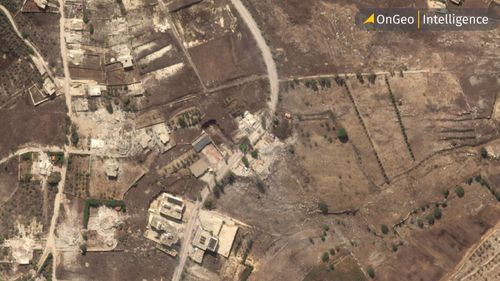
Discover how satellite imagery, SAR radar, and night-time lights measure the economic cost of war when field surveys fail. Learn the 4-step pipeline turning pixels into financial losses, validate data accuracy, and find out how humanitarian agencies, insurers, and property owners use remote sensing to assess damage in minutes.
Read more
How Satellites Save Lives During Natural Disasters Within Hours
2026-09-23
~ 6 min
(Article updated: 2026-09-23)
Discover how satellite imagery helps save lives during natural disasters. Within hours of a flood, earthquake, or wildfire, global systems like the International Charter and platforms like OnGeo Intelligence deliver critical radar and optical data to first responders penetrating cloud cover, mapping damage extents, and accelerating rescue operations across the globe.
Read more
How Satellites Monitor Climate Change
2026-09-04
~ 7 min
(Article updated: 2026-09-04)
Satellites provide an unbroken, global perspective on climate change that local stations cannot match. By tracking sea levels, ice mass, and CO2 emissions over decades, space missions deliver the reliable data needed to identify long-term environmental trends.
Read more
Shocking Satellite Images from Nepal Deadly Flash Flood
2026-08-27
~ 5 min
(Article updated: 2026-08-27)
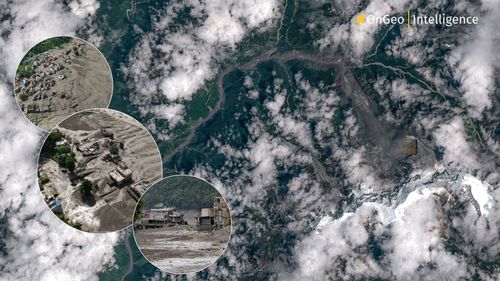
Satellite images reveal how a deadly glacial collapse triggered a devastating flash flood along the Nepal–Tibet border, destroying infrastructure and settlements. Before-and-after imagery helped scientists confirm the event’s origin and assess the scale of damage, highlighting the critical role of Earth observation in remote, high-altitude disaster zones.
Read more
Orbital Altitude as Mission Architecture Comparing Geostationary and Low Earth Regimes
2026-08-25
~ 6 min
(Article updated: 2026-08-25)
Orbital altitude is a fundamental mission-design choice shaping satellite coverage, latency, power, constellation size, radiation exposure, and end-of-life strategy. This article compares Geostationary Earth Orbit (GEO), Low Earth Orbit (LEO), and Medium Earth Orbit (MEO), explaining their key advantages, limitations, applications, and architectural trade-offs in satellite communications, Earth observation, and navigation.
Read more